Debentures in Nepal vs fixed deposits: what they really pay (and the SVB lesson)
Bank deposit rates in Nepal have fallen to about 3% - the average was 3.15% in August 2026, by Nepal Rastra Bank's figures - and many savers are looking for something that pays more without the swings of shares. Debentures listed on NEPSE look like the answer: most carry coupons of 8% to 11%. But a debenture's coupon is not what you earn if you buy it on the market today. We checked every debenture trading on NEPSE, and the gap between what they appear to pay and what they really pay is large.
What a debenture is
A debenture is a loan you make to a company - in Nepal almost always a bank or a finance company. It has a face value of Rs 1,000 per unit, a fixed interest rate (the coupon), usually paid twice a year, and a maturity date, when the company pays the Rs 1,000 back. An 8.5% debenture pays Rs 85 a year per unit until it matures.
When a debenture is first issued you pay Rs 1,000. After it lists, it trades on NEPSE like a share, and its price moves. That is where the confusion starts.
Three numbers, not one
- Coupon - the fixed interest on the Rs 1,000 face value. It never changes.
- Current yield - the coupon divided by today's price. Buy a 10% debenture at Rs 1,119 and the Rs 100 of interest is 8.9% of what you paid.
- Yield to maturity - your real yearly return if you buy today and hold to the end. It counts the interest and the Rs 119 you lose when the company pays back only Rs 1,000. For that same debenture with three years left, it is about 5.6%, not 10% and not 8.9%.
Yield to maturity is the number to compare with a fixed deposit. The coupon is the number printed in the name - and the one most people quote.
What the data shows: a glimpse
We looked at every debenture and bond that traded on NEPSE in the month to mid-October 2026, and worked out each one's yield to maturity from its last traded price.
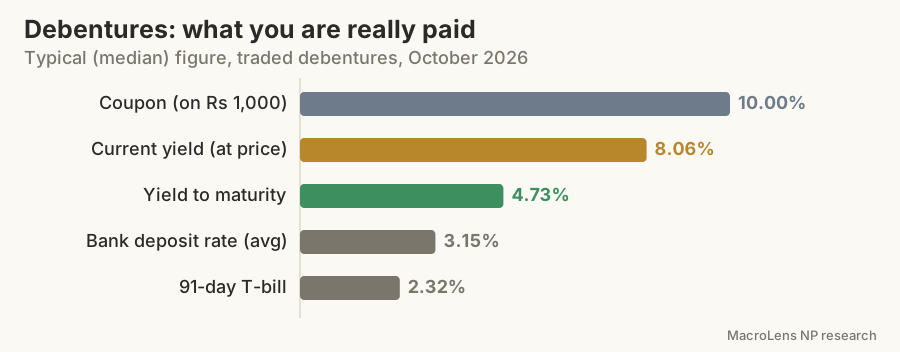
| Debentures trading, October 2026 | Typical (median) |
|---|---|
| Coupon | 10% |
| Price (face value Rs 1,000) | Rs 1,119 - every one traded above face value |
| Current yield | 8.1% |
| Yield to maturity | 4.7% |
| Years left | 3 |
| Bank deposit rate (NRB average) | 3.15% |
So debentures still pay more than a deposit - about 1.5 points more to maturity for the typical one - but far less than their coupons suggest. Every single one was priced above Rs 1,000: the debentures were issued when interest rates were higher, and as rates fell, buyers bid their prices up. That premium is money you do not get back.
The holders who bought at listing did well: for the 41 debentures we could follow from their first trade, buying at listing and holding to maturity works out to a median of about 9.3% a year - roughly the coupon, because they paid close to Rs 1,000.
Global case study: Silicon Valley Bank, 2023
The other side of falling rates is rising ones. In 2022 the US Federal Reserve raised its policy rate from near zero to over 4%. The 10-year US government bond yield went from about 1.5% to nearly 4%, and a broad index of high-quality US bonds lost about 13% - its worst year on record. Nothing defaulted. Prices simply fell, because new bonds now paid more than the old ones.
Silicon Valley Bank had put a large part of its deposits into long-dated, very safe bonds bought when yields were low. By the end of 2022 those bonds were worth roughly $15 billion less than the bank had paid. On 8 March 2023 it announced it had sold $21 billion of them at a $1.8 billion loss and needed new capital. Depositors panicked and tried to withdraw $42 billion the next day. On 10 March the regulators closed the bank - at the time the second-largest bank failure in US history.
The lesson is not that bonds are dangerous. Held to maturity, SVB's bonds would have paid back in full. The danger was being forced to sell before maturity after rates rose. A bond's price risk is measured by its duration: roughly how many percent the price falls when rates rise by one point. The typical NEPSE debenture has a duration of about 2.7 years - if Nepal's rates rose by one point, its price would fall by about 2.7%.
Risks specific to Nepal's debentures
- The issuer. A debenture is only as good as the bank behind it. In a failure, debenture holders are paid after depositors but before shareholders. A weaker bank pays a higher coupon for that risk - check its health on the free stock pages.
- Selling before maturity. Some debentures trade most days; a few trade a handful of times a year. If you may need the money early, check how often it trades.
- The premium. Paying Rs 1,119 for something that returns Rs 1,000 is fine if the yield to maturity still beats your alternatives - but know that the price must drift down to Rs 1,000 by the end.
- Tax and fees. Interest is taxed at source and buying on NEPSE costs broker commission, so your take-home yield is a little lower than the headline.
What this means for you
- Compare yield to maturity with a deposit, never the coupon.
- New debenture issues bought at Rs 1,000 yield their coupon - the market ones mostly do not. Watch the debenture list and new issues.
- Match the maturity to when you need the money, and you can ignore price swings in between.
The full study
This post shows only the headline numbers. Inside the MacroLens NP desk, every debenture has its own page: yield to maturity against the bank rate, what Rs 1 lakh made if bought at listing or at the low or sold at the peak, a calculator for any buy date, how interest compounds, and each one's risks in plain words. Start your free 7-day trial, or sign in if you already have an account.
This is research on past prices, not investment advice. Maturity dates are estimated from the year in each debenture's name, and interest is assumed twice a year.
Source: MacroLens NP analysis of NEPSE debenture prices and Nepal Rastra Bank data, October 2026. Chart: MacroLens NP. Cover photo: public domain.